
The record of the new government would be spotless but for the increase in rail fares and the delay in gas price hike

Here are the key decisions announced by the Reserve Bank of India on Thursday.

This is contrary to the expectations of a majority of analysts predicting for another hike given the rise in inflation lately, including domestic ratings agency Icra

The prices will be decided during the time of launch, as TVS hopes that given the cost increase, the government may consider bringing down GST for two-wheelers.
According to the announcement made by chief minister Y S Rajasekhara Reddy yesterday the new wages would be paid to workers under NREGP from May 21 onwards. Reviewing the progress of NREGP works, the chief minister directed district collectors to take up and complete all works under the programme before the onset of monsoons so that funds available could be fully utilised.
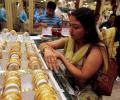
Gold jewellery demand in India is likely to decline in the second and third quarters of this fiscal due to hike in import duty, high volatility in prices and inflationary pressure, according to a report. While demand is likely to contract by 8 per cent year-on-year in the second quarter of FY23, the decline is expected to be higher at 15 per cent in the third quarter due to the exceptionally high base in the same period of FY22, Icra said in a report. According to the report, the exceptional third quarter performance in FY22 was due to the post-Covid reopening of the economy and the substantially high demand in the wedding and festive seasons.

As soon as the House met at 2 pm, papers were laid on the table and two resolutions adopted amid slogan shouting and protest by Congress members.
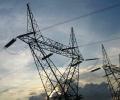
The statement comes in the wake of reports that warned of power crisis looming large due to the coal shortage in the country.

Congress leader Rahul Gandhi and other Opposition leaders presided over a meeting to discuss strategy for the remaining period of Parliament

With a revival in demand and consumption, FMCG companies are looking forward to 2022 with positivity and hopes of sustaining a healthy growth trend across both rural and urban markets while gearing up to cater to the ever-increasing digitally active consumers and tackle the challenge of higher commodity prices. Health and wellness and convenience are going to remain key trends and FMCG companies are strengthening their core brands, driving premiumisation across their portfolios with targeted innovations as consumers are gravitating towards trusted brands looking for quality, purity and hygiene, in continuation of the trend that started since the pandemic last year. FMCG makers are accelerating digitalisation and are investing in building capability in e-commerce and Direct-to-Consumer channels, identifying it as a key vector of their growth as the threat of a possible third wave is still not away.
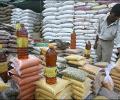
The agricultural supply system has to be able to respond to this increasing demand, which it is not able to do.

The BMC election will hold the key to a new shift in political power -- not just in Mumbai but in Maharashtra, reports Sarthak Choudhury.

Investors continue to back-up equity mutual funds in June as such schemes attracted a net inflow of Rs 15,498 crore on strong flows from systematic investment plans despite volatility in the stock market and relentless selling by Foreign Portfolio Investors (FPIs). This also marked the 16th straight month of positive inflow in equity schemes. Inflows into equity mutual funds in June was lower compared to the net inflow of Rs 18,529 crore seen in May, data from the Association of Mutual Funds in India (AMFI) showed on Friday.

The salary hike for government employees is likely to put an additional burden of Rs 24,000 crore on the state excheque.

The pay hike has been made effective from January 1, 2016.

India's current account deficit is expected to deteriorate in the current fiscal on account of costlier imports and tepid merchandise exports, according to the Finance Ministry's monthly economic review. The review released on Thursday by the ministry also said that global headwinds would continue to pose a downside risk to growth as crude oil and edibles, which have driven inflation in India, remain major imported components in the consumption basket. For the present, it said, "their global prices have softened, as fears of recession have dampened prices somewhat. This would weaken inflationary pressures in India and rein in inflation."

Opposition members led by Trinamool Congress MP Sukhendu Sekhar and Congress leader Mallikarjun Kharge asked the government to clear its stand over the nationality of the minister. Without naming the minister, Sekhar said: "The prime minister has been allowed to lay a list of the ministers after the reshuffle. Go through Wikipedia, then you will find that the name of the gentleman... a minister of state for home affairs is a reportedly a Bangladeshi." Sekhar was also supported by Kharge and other opposition members.
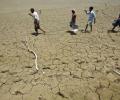
Rain deficiency in eastern and western Uttar Pradesh, Bihar, Jharkhand, Gangetic West Bengal, Assam and Meghalaya is 20-46 per cent less than normal as of June 17.

The demand was made by the Nationalist Congress Party, the Trinamool Congress and the Dravida Munnetra Kazhagam.

Some states are taking a legal view on the state GST rate and the compensation rules ahead of the Goods and Services Tax (GST) Council meeting, which is likely to be held in mid-June, said people in the know. While the agenda is still being finalised, several states are likely to take up the matter related to GST compensation and may pitch for its continuation beyond the June 30 deadline. States would like to know how they would divide the compensation collected after June 2022 for payment of principal and interest of compensation shortfall borrowing and arrears to states, sources said.

Gold has pushed lower as a result of Chinese selling.

High frequency indicators suggest that a growth recovery is underway, but very tentatively and with weak legs, says Saugata Bhattacharya.

The second half of June could be driven more or less by technical factors triggered by news flow from Greece, the US Federal Reserve and the monsoon. The technical picture seems bearish as of now, says Devangshu Datta.

What is more worrying, according to the report, is the fact that in over 20 per cent of the topic caseload districts where the second has ebbed, the third wave has set in firmly, which was only 5 per cent a month ago.
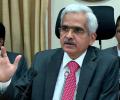
To a specific question on the change in RBI's stance from "neutral" to "accommodative", Das said it means that there will not be any rate hike from here on.
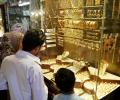
Gold discounts in India, the world's second-biggest consumer, widened this week as dealers struggled to offload stocks amid sluggish demand.

Despite a rise in input costs, leading car-makers refrain from hiking their price.

India will raise its import duty on sugar to 40 percent from 15 percent, as the government tries to revive business at mills that owe farmers around $1.84 billion, the food minister said on Monday.

Movements in gold prices will depend on the US' interest rates.

'When Covid first struck, the lockdown resulted in clean air in major Indian cities.' 'You were able to see the Himalayan range from Ludhiana.' 'In Delhi, you were seeing deer and stags all over the city because there was no traffic.' 'It was incredible. Nature was waiting to come back.'
With a bountiful harvest and stalled infrastructure projects starting, India growth story is intact.

If El Nino condition affects the monsoons, as is being forecast by foreign agencies, it can slow down the economy to 5.2 per cent next fiscal from a projected 6 per cent.

The state plans for 4 per cent growth in agriculture and 11 per cent each in industry and services sector.

Good monsoon, farm loan waiver -- the two key reasons behind more customers in jewellery shops

'The recent US jobs report has eased fears of a hike in the Fed meeting.'
Is this price-rise artificial? What do you think is causing it? Hoarding by unscrupulous traders? Too many middlemen? Tell us.\n

Already reeling under a demand slump, automobile manufacturers have expressed disappointment over the RBI's decision to hike short term lending rate saying it is likely to impact the interest rates on car and automobile loans further.
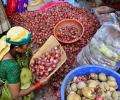
Assembly elections in Maharashtra are scheduled later this month. The farmer protests are likely to affect the results, especially in the onion-growing belt of Nashik.

Proceedings in Rajya Sabha were repeatedly disrupted on Monday before being called off for the day as opposition members protested on the alleged phone-tapping and other issues and demanded discussions on them in the House.
